
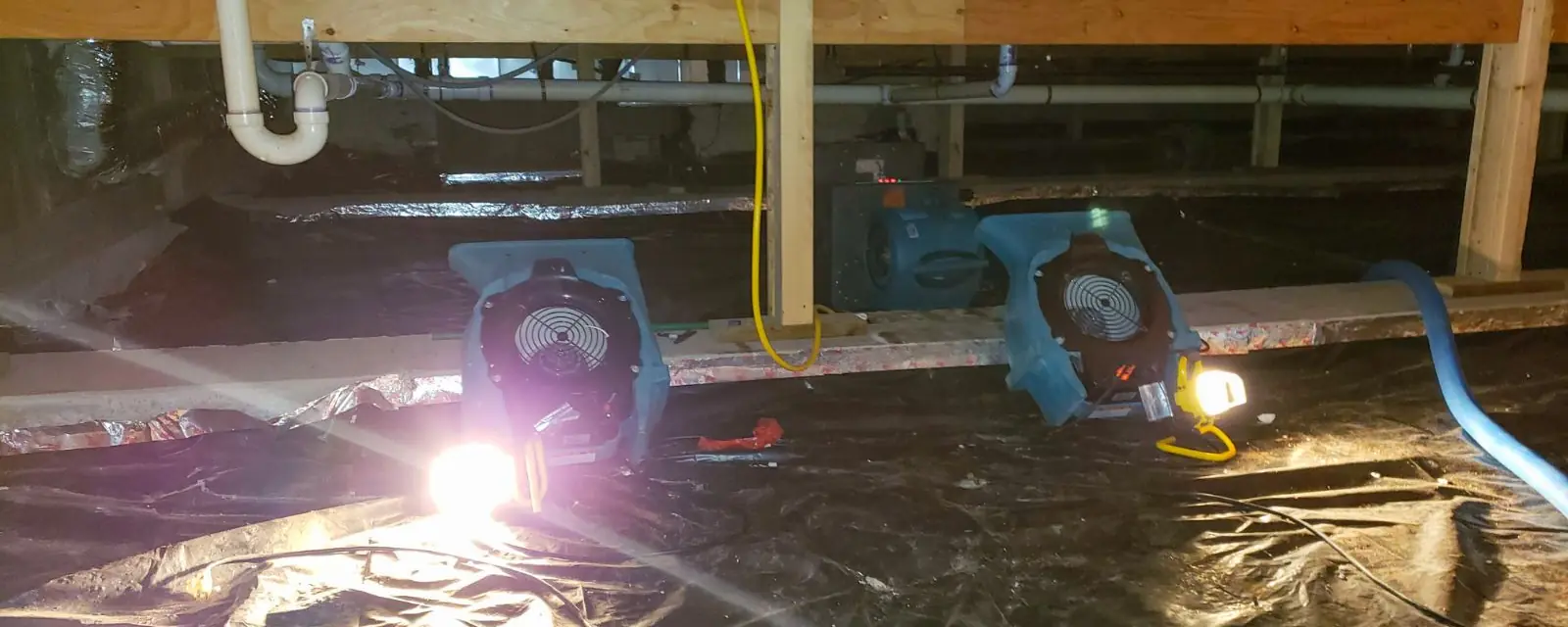
Crawl space mold remediation is the work of finding why the cavity under a raised foundation stays damp, removing or cleaning the affected wood and insulation, and drying the space so growth has nothing to feed on. In a Buena Park home that space is rarely seen, so small leaks can run for months. This guide covers the moisture sources, the cleanup steps and how to judge the job.
Why the space under the floor gets damp
Mold needs moisture, organic material and time. A crawl space supplies the material for free, since floor joists, subfloor sheathing and paper-faced insulation are all wood or paper. What it needs from you is a water source, and there are only a handful of realistic ones.
The most common is plumbing. Supply lines, drain lines and water heater connections often run through the joist bays, and a pinhole leak at a copper joint can drip for a long time unseen. Drainage is the second source, where a downspout or irrigation head near the foundation pushes water toward the perimeter. The third is humid air that enters through foundation vents and condenses on cool surfaces such as ducts and pipes.
What you can see from the access hatch
Before anyone crawls in, a look through the access hatch with a bright flashlight tells you a lot. Dark speckling on the underside of the subfloor, fuzzy white or gray patches on joists and a heavy earthy smell are all reasons to get the space assessed. So is insulation that has dropped away from the floor and hangs in damp clumps.
Also look at the ground. Standing water, a dark stain spreading from one corner or a soil surface that stays soft days after dry weather points to an active supply, not old damage. A technician will confirm this with a pin-type moisture meter pressed into the joists and a thermal imaging camera swept across the floor above, since cool wet patches show up clearly on a thermal image.
Fix the water first or the work is wasted
Cleaning mold off wood while a leak still drips onto it is a repeat visit waiting to happen. The sequence matters: stop the source, dry the space, remove what cannot be saved, clean what can, and only then close things up. A reputable company will say this plainly in its written scope, and will tell you if a plumber or drainage contractor has to come first.
If the source turns out to be a plumbing failure, the leak itself is a plumber's job, while the wet materials left behind belong to a restoration crew. Our water mitigation service covers that drying stage, using air movers and LGR dehumidifiers set up to pull moisture out of framing without baking the house above.
Suspect mold under your floor?
Describe what you saw from the hatch and we will explain how an assessment works for a raised foundation in Buena Park, CA.
Vapor barriers and insulation: keep, replace or remove
A vapor barrier is a sheet of heavy polyethylene laid over the soil to slow moisture rising from the ground. If it is torn, bunched up or missing in sections, the soil breathes into the space all season. Crews usually remove a badly soiled barrier, clean the soil surface and lay a new one with overlapped, taped seams that run a little way up the foundation walls.
Insulation is a harder call. Fiberglass batts stuck to the underside of a wet floor tend to hold moisture against the wood and are normally removed and bagged. Rigid foam board can often be wiped down and kept. The dividing line is whether the material is porous and has been wet, because porous material that has grown mold is generally replaced rather than cleaned.
Buena Park: sewers, shutoffs and flood maps for a raised foundation
The City of Buena Park runs its own water utility, with about 19,000 service connections and roughly 225 miles of pipeline. The main shutoff valve is on your property, so if you hear running water under the floor and see no fixture in use, locate that valve first. A leak between the street and the meter belongs to the city utility, so call the city for the street side and a plumber for everything after the meter.
OC San runs the regional sewers, and its Buena Park Sewer Improvements Project covers just under a mile of pipe and 40+ manholes along Beach Blvd, Knott Ave and Valley View St, with construction planned for 2027 to 2028. Those sewers were built between 1959 and 1998 and inspections found cracks. If several fixtures back up at once and water appears under the house, call the sewer agency and treat it as Category 3 sewage, not a mold job.
Most of Buena Park sits in the FEMA 500-year flood zone, with 100-year zones mainly along the southeastern border. Check the FEMA Flood Map Service Center for your exact address, and ask the Buena Park Building Division whether any rebuild work under your floor needs a permit.
Working safely in a confined space
Crawl spaces are cramped, dark and sometimes only a foot or two high. Crews wear a half-face or full-face respirator with P100 filters, disposable coveralls, gloves and eye protection, and they bring their own lighting so they are not working near a bare bulb on a damp circuit. Any wiring that has been wet gets switched off at the panel before work begins.
Older homes can also hide asbestos-wrapped pipe insulation or duct wrap. If you see white or gray fibrous wrap on pipes, do not pull it off. Test before you scrape, and leave suspect material to a professional.
What a professional cleanup looks like
Assess and write the scope
The crew measures the affected joists and subfloor, maps moisture readings and writes down what will be cleaned, what will be removed and what is out of scope.
Contain the work area
Plastic sheeting seals the hatch and any floor penetrations, and a HEPA air scrubber runs to hold air pressure so dust does not drift into the living space.
Remove and clean
Damaged insulation and soiled barrier come out in sealed bags. Surface growth on solid framing is removed with HEPA vacuuming and abrasive cleaning, followed by antimicrobial treatment where the scope calls for it.
Dry and verify
Air movers and dehumidifiers run until moisture meter readings in the wood return to a normal dry range, then the barrier and insulation go back in.
Clearance and what comes after
The last step is proving the work is done. Many homeowners ask for clearance testing by a third party who has no stake in the cleanup, which avoids the awkward situation of the contractor grading its own work. Ask for the lab report and keep it with your house records.
Nobody can honestly promise that mold will never return, because that depends on moisture. What you can do is keep gutters and downspouts directing water away, repair leaks quickly, keep foundation vents unblocked and glance into the hatch after heavy rain. Crews also serve nearby cities such as Fullerton and Anaheim, so if you work across town the same process applies.
Vetting a company for this job
California has no state licensing of mold remediators, according to the California Department of Public Health, and the state has no regulations covering mold inspection or remediation. Construction work of $500 or more does require a contractor's license, so ask any company for its California contractor license number and check it with the state board. Our team is licensed and insured, and you can read about the mold remediation service before you call.
Ask what standard the crew follows. ANSI/IICRC S520 is the published industry standard for mold remediation, and any company should be able to tell you how its crews apply it. Then compare written scopes line by line, because two quotes can differ simply because one leaves out containment or drying.
Questions from Buena Park homeowners
Can I clean crawl space mold myself?
Small, dry surface spots on solid framing can sometimes be handled with a HEPA vacuum and a respirator, but crawl spaces are tight and hard to ventilate. If the growth covers a large area, sits on insulation or follows a leak you have not found, hire a professional. Health questions about exposure belong with your physician.
Is a vapor barrier enough to stop mold?
No. A barrier slows moisture rising from soil, but it does nothing about a plumbing leak, a drainage problem or humid air entering through vents. It works as one layer in a plan that starts with removing the water source.
How long does crawl space drying take?
It depends on how wet the framing is and how large the space is. Crews take moisture meter readings at the start and after each visit, and the job continues until the wood reads dry, not until a set number of days has passed.
Does homeowners insurance cover crawl space mold?
Often only when it follows a sudden and accidental event such as a burst pipe, while long-term seepage and neglect are commonly excluded. Check your policy and ask your insurer, and photograph the damage before anything is removed.
My Buena Park home has a crawl space. Does a leak under the street affect it?
A leak between the street and your meter is the City of Buena Park utility's responsibility, while a leak after the meter is yours. If the ground near the foundation is wet, close the main shutoff valve on your property to see whether the water stops, then call the city or a plumber accordingly.