
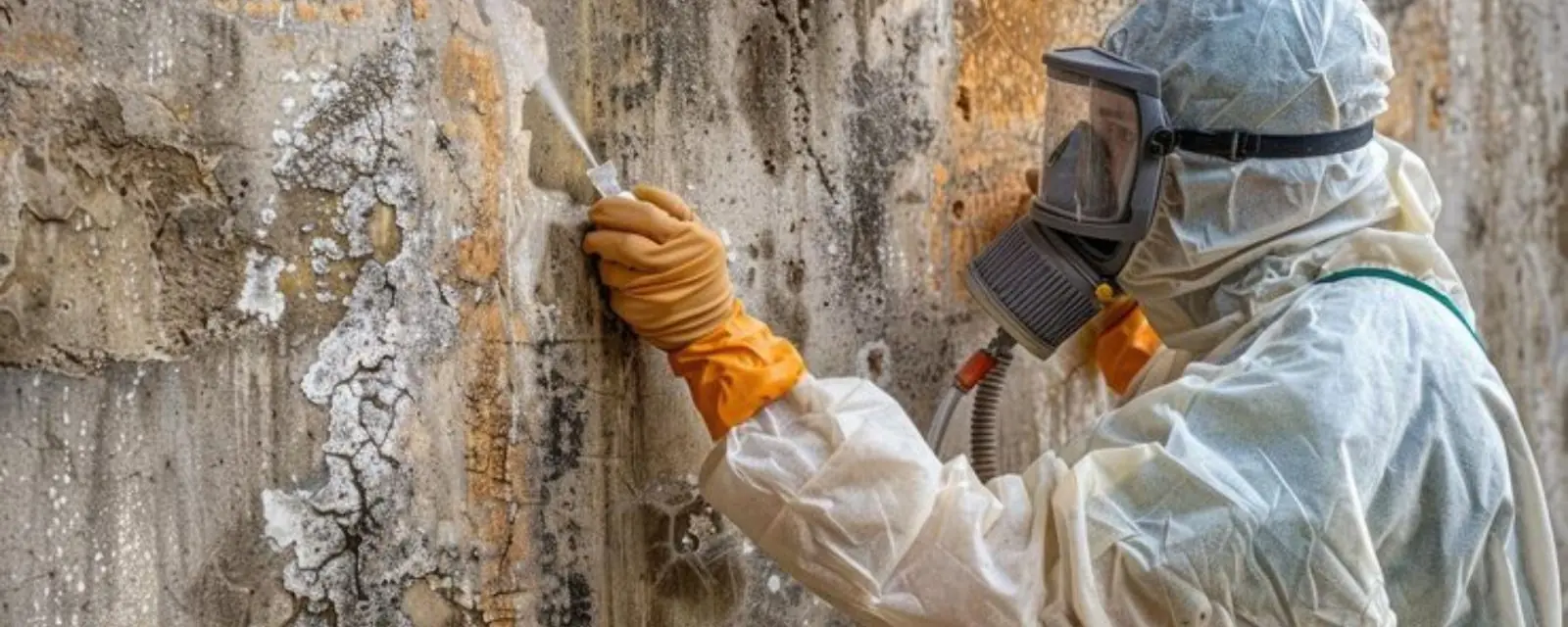
Knowing how to remove mold from wood begins with one question: is the growth sitting on the surface, or has it softened the board? Surface growth on a rafter, a deck rail or an old dresser can often be cleaned and dried. Rot that has gone into the fibers cannot. Homeowners in Buena Park, CA, tend to run into this in garages, attics, backyard decks and furniture stored against a damp wall.
Test the board before you clean it
Press a screwdriver or awl into the wood at the edge of the stain. Sound wood resists and the tip barely marks it. Wood that has been attacked by rot lets the tip sink in, feels spongy and breaks away in long strands or cubes.
Tap along the board and listen. A solid knock means dense fiber, and a dull thud can mean the inside is soft. Check the underside too, since the face of a board may look fine while the back is damp.
Take a reading with a moisture meter. Wood in a dry indoor space generally sits in a low range, and readings well above that mean the board is still taking water. Cleaning a wet board is pointless, so trace the source first.
Where wood gets wet in a typical house
In attics, the usual culprits are a roof leak, a bathroom fan that dumps steam into the space instead of outside, and a poorly sealed duct. Warm humid air hits cool sheathing and condenses on the underside, leaving gray or black speckles along the nails.
In garages, water enters at the slab edge, from a leaking water heater, or when a washing machine hose fails. Furniture, cardboard boxes and stored lumber pull in that moisture. Behind a backyard fence or against a deck, wood stays damp wherever sprinklers hit it.
Subfloors under tile, vinyl or laminate get wet from a slow plumbing leak. The surface covering hides the problem for months. If a floor feels soft or smells musty, the wood underneath needs a look, which our water mitigation team can map with meters and a thermal camera.
Surface growth on solid wood: the cleaning sequence
Protect yourself first. Wear an N95 or better respirator, goggles, gloves and clothing you can wash right away. Take outdoor pieces outside, and for attic or garage framing, wet-wipe or vacuum before you brush so you are not raising dust.
- Run a HEPA-filtered vacuum over the surface to lift loose spores and debris. A regular shop vacuum can blow fine particles back into the room.
- Clean with a soft brush and a mild detergent solution. For rough sawn framing a stiff nylon or wire brush works, always brushing along the grain.
- Wipe the surface with a damp, clean cloth and change the cloth often.
- Dry the wood quickly with fans and a dehumidifier, or in direct sun for outdoor furniture.
- Vacuum once more with the HEPA unit when the surface is dry, then recheck with the moisture meter.
Dispose of rags and brushes in sealed bags. Washing the same brush in your kitchen sink moves the problem to a new place.
Sanding, wire brushing and other trade-offs
Sanding removes the stained layer and leaves clean wood, but it also throws fine dust into the air. Done in an attic or garage without containment, it spreads growth to other framing. A wire brush is slower and produces less dust, though it can gouge soft pine and leave fibers that hold moisture.
Professional crews often use dry abrasive methods such as sanding or media blasting inside containment, with a HEPA air scrubber running. Dry ice and soda blasting are also used on framing because they clean crevices a brush cannot reach. These methods cost time and equipment, so a crew uses them when the area is large.
Stains are different from growth. Dark staining may remain even after the surface is clean. If the wood is dry, sound and clean, a faint stain alone is not a reason to remove it.
When wood has to be replaced
Replace boards that are soft, crumbling, delaminated or cracked across the grain. Structural members need a different level of caution. A rotted joist, a stud at the base of an exterior wall or a rafter tail near a leak should be evaluated by a contractor before anyone cuts it.
Plywood and OSB are more vulnerable than solid lumber. Their layers or strands swell with water and do not return to shape. Sheathing that has grown mold throughout and is delaminating is usually cut out and replaced, rather than cleaned.
Ask the Buena Park Building Division whether replacing framing or sheathing requires a permit. Our water damage repair crews can handle the rebuild once the area has dried and cleared inspection.
Not sure if a beam or rafter is sound?
Call and describe what you see and where. We can tell you whether it sounds like a cleaning job or something a crew should open up.
Sealers and encapsulation: use caution
It is tempting to roll on a sealant once the wood looks clean. Paint-on encapsulants are used in professional work, but only after the wood is dry and the moisture source is fixed. Applied over damp lumber, a coating traps water and can cover failure that needs attention.
Do not seal a board you have not tested. Allow the wood to reach a normal moisture reading, confirm that growth is gone, then ask the product maker which treatments suit your surface. Outdoor decks have different needs from interior studs.
Mold needs moisture. No coating can promise that growth will never return, so ventilation, drainage and leak repair still do the main work.
Buena Park: winter storms and wood outdoors
The National Weather Service reports a 1991 to 2020 normal of 14.25 inches of rain a year for Downtown Los Angeles, with February the wettest and August the driest month. That is a regional figure and not a Buena Park station reading, but it shows the pattern, with a few winter storms delivering most of the rain.
After each storm, check garage framing, fence posts, deck boards and attic sheathing for damp spots, since dry months can hide a leak that only shows up in a storm.
If you find structural wood that needs replacement, ask the Buena Park Building Division whether the repair needs a permit. Also keep a record of when the leak began, because insurers separate sudden and accidental damage from gradual leaks, and your policy language controls what applies.
Clean it yourself or hire out
A small patch on a dry board with a known cause is a reasonable do-it-yourself job. Growth across several joists, a damp attic, wood near HVAC ducts or sheathing that is delaminating is not. Our mold remediation team works inside containment with HEPA filtration for those cases.
California does not license mold remediators, according to the state Department of Public Health, but contractor work of $500 or more needs a state contractor's license. Ask any company for it. We also work in La Palma and Cypress, and crews carry the same HEPA vacuums and air scrubbers to each job.
Questions from Buena Park homeowners
Can moldy wood be saved?
Often yes, if the board is dry, firm and only the surface is affected. Wood that is soft, crumbling or delaminated should be replaced. A screwdriver test and a moisture reading will usually tell you which one you have.
Is sanding the best way to remove mold from wood?
It works, but it makes dust that can spread growth if you sand without containment. A HEPA vacuum, a soft brush and a damp wipe are gentler for small areas. Large attic or garage areas are usually handled by a crew with air scrubbers.
Can I paint or seal wood after cleaning it?
Only after it is dry, the cause is fixed and the growth is gone. Sealing damp wood traps moisture and may hide a problem. Ask the coating maker whether the product suits your surface.
Why does mold keep returning on my attic wood?
Something keeps the wood damp, most often a bathroom fan venting into the attic, a roof leak or poor airflow. Surface cleaning does not change that. Fix the moisture, then clean and dry the framing.
Does a dry climate like ours mean wood in Buena Park will not grow mold?
No. The regional climate is dry, with most rain falling in a few winter storms, but wood only needs to stay damp for a while. Leaks, sprinklers and condensation in garages and attics can supply that moisture.