
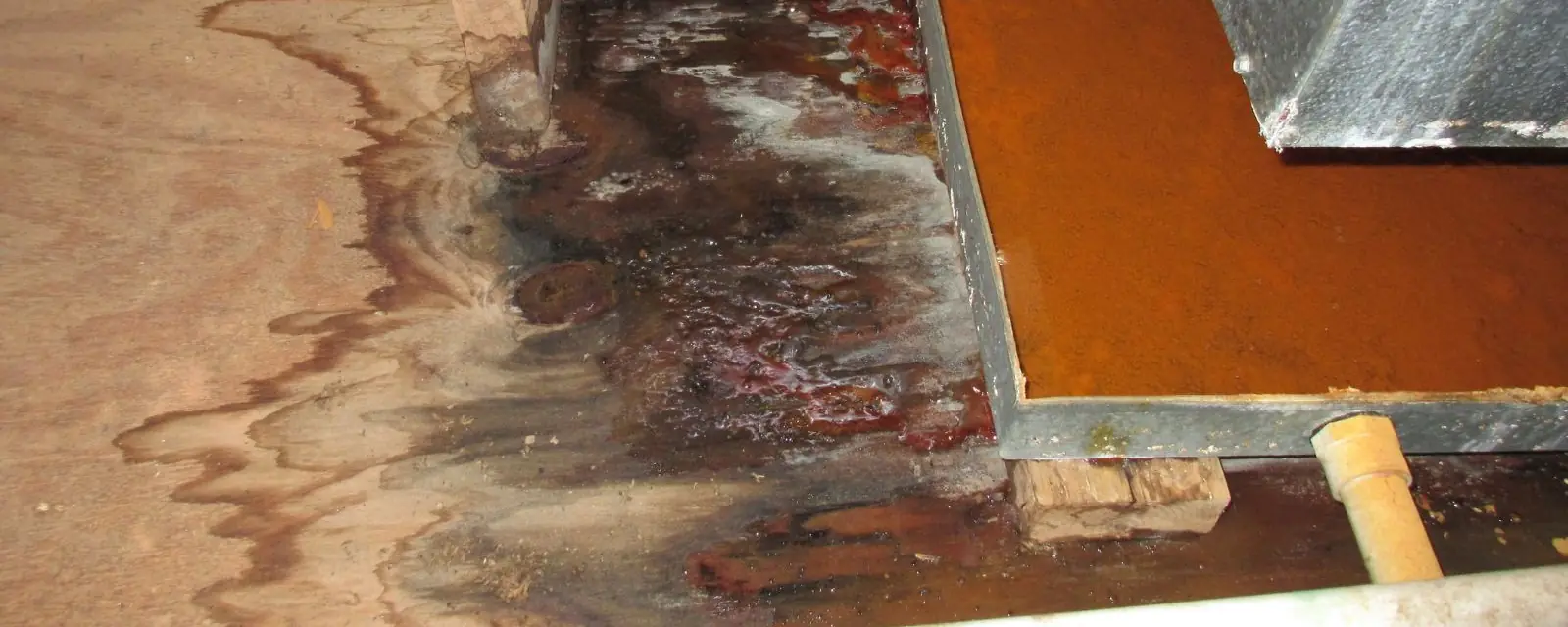
To fix a water damaged wood floor, you first have to stop the water, then dry the boards and subfloor completely, and only then decide whether to sand and refinish or replace. Wood absorbs moisture through its underside, so a floor can look fine for a day and warp within a week. If you have just found a wet floor in Buena Park, this guide covers what the damage shapes mean and what to do first.
Read the shape of the damage
Wood reacts to moisture in recognizable ways. Cupping means the board edges rise higher than the center, which happens when the underside absorbs more water than the top. Crowning is the reverse, with the center higher than the edges, and it often appears when a cupped floor is sanded before it dries. Buckling is the severe case, where boards lift off the subfloor in a ridge.
Cupping is often reversible if drying starts early. Buckling usually means the fasteners or glue have let go, and boards on the ridge often need replacing. Check with a flat straightedge across several boards so you see the pattern and not just one bad spot.
What to do in the first hours
Stop the water, shut the supply valve if a line has failed and soak up standing water with towels or a wet vacuum. Remove rugs, furniture legs and anything that traps moisture against the wood. Dry rugs elsewhere and lift the pad, since foam padding holds water against the finish for days.
Photograph everything before you move it, including the floor, the source and the wet walls. Keep air moving with a fan, but do not crank up the heat. A hot air blast pulls moisture off the surface faster than it leaves the core, and that mismatch splits the wood and opens the seams.
Why the subfloor decides the outcome
The boards are only half the story. Water travels into the plywood or plank subfloor, and into the air gap below if the house has a raised foundation. A pin-type moisture meter pushed into the board reads the wood itself, while a pinless meter scans a wider area, and the readings are compared to a dry reference board.
On a slab-on-grade home, moisture can also rise from the concrete, so crews test the slab before and after drying. Sealing a floor, installing new planks or applying finish over a damp base traps moisture, which is how a repair that looks perfect in week one begins to cup again in week six.
Floor cupping after a leak?
We can read the moisture levels in the boards and subfloor and explain your options in Buena Park, CA.
How drying works and how long it takes
Professional floor drying uses air movers, LGR dehumidifiers and sometimes mats that pull moisture up through the boards from below. Crews open the room, remove baseboards so the wall cavity can vent and take readings every day. The finish is the main barrier, so some systems drill tiny relief holes or lift a board to give vapor a path.
Hardwood can take days to weeks to dry down, depending on thickness, species and how long it was wet. The target is not a calendar number. It is a reading that matches the dry reference and holds steady on two consecutive visits.
Sand and refinish, or replace
| Situation | Likely outcome | Why |
|---|---|---|
| Light cupping, dried quickly | Often flattens, then sand and refinish | Boards relax as moisture leaves |
| Cupping that remains after drying | Sand carefully or replace affected boards | Memory in the wood may hold the curve |
| Buckling or lifted boards | Replace the affected area | Fasteners or glue have failed |
| Black staining, soft or rotted wood | Replace | Fibers are damaged below the surface |
| Category 3 water | Remove and replace | Contaminated water cannot be cleaned out of wood |
A professional assessment should be in writing before any sanding starts.
Sanding too soon is the classic mistake. If the floor still holds moisture, sanding flattens the cup, and when the wood finishes drying the edges shrink and the center stays high, leaving a crowned floor that cannot be fixed without more removal. Wait for stable moisture readings, which can mean weeks, and ask the sander how they confirmed dryness.
Nail-down, glue-down, engineered and laminate
Solid hardwood nailed to a wood subfloor can often be dried in place. Glue-down floors are harder, because adhesive softens in water and the planks can release, and drying in place may not be possible. Engineered wood has a thin top layer over plywood layers and can delaminate, so once the layers separate the board is replaced.
Laminate is different again. The core is compressed fiberboard that swells at the edges and does not return to its original thickness, so wet laminate is almost always replaced. Vinyl plank is waterproof on top but water can still sit under it, so lift a plank and check.
Buena Park: sewers, flood zones and floor water
Most of Buena Park is in the FEMA 500-year flood zone, with 100-year zones mainly along the southeastern border. Floodwater is Category 3, and wood that has absorbed it is normally removed rather than saved. Check the FEMA Flood Map Service Center for your address, and ask your insurer about separate flood coverage, since homeowners policies usually exclude flood.
OC San manages the regional sewers, and its Buena Park project covers streets such as Beach Blvd, Kingman Ave and Artesia Blvd, with sewers built between 1959 and 1998 and construction planned for 2027 to 2028. If water backs up in several fixtures and soaks the floor, call the sewer agency and treat the water as sewage, because a sewage-soaked wood floor is not something to dry and refinish.
Mistakes that cost the most
- Covering the floor with new flooring or rugs before it is dry.
- Using space heaters or heat guns to speed things up.
- Sealing the floor with a coat of finish while the wood still holds moisture.
- Ignoring the wall bottoms, where the base trim and drywall wick water up from the floor.
- Skipping a test for mold on the underside of the boards when a musty smell lingers.
If a musty smell hangs around after the floor is dry, ask about mold remediation before laying anything new, and keep health questions about exposure for your physician.
Choosing help and what to expect
Start with the drying, then the repair. Our water mitigation crews handle moisture mapping and drying, and the water damage repair team handles board replacement and finish work. Ask for moisture readings in writing and for a clear statement of which boards are being saved.
Crews also work in Fullerton and La Mirada. Sudden and accidental water damage is often covered by a policy, while a slow leak under the floor often is not, so check your policy and ask your insurer.
Questions from Buena Park homeowners
Will a cupped hardwood floor flatten on its own?
Sometimes, if it dries slowly and fully. Many floors stay slightly cupped and need sanding after the moisture reading stabilizes, so do not sand until the readings hold steady.
How long should I wait before sanding?
Until moisture meter readings in both the boards and subfloor match a dry reference and stay steady across visits. For some floors that means weeks, not days.
Can laminate flooring be saved after a leak?
Rarely. The fiberboard core swells and does not shrink back, so most wet laminate is replaced.
Do fans and heaters dry a wood floor?
Fans help, but heat can split the boards. Controlled drying with dehumidifiers and air movers moves moisture out evenly.
Does a Buena Park flood zone affect my wood floor repair?
Yes. Flood water is Category 3, so wood it soaked is usually removed. Most of the city is in the FEMA 500-year zone, so check the FEMA map for your address and ask the Building Division about floodplain rules before rebuilding.